Moving a Grand Piano in the Eastern Harbour: what actually happens on the day
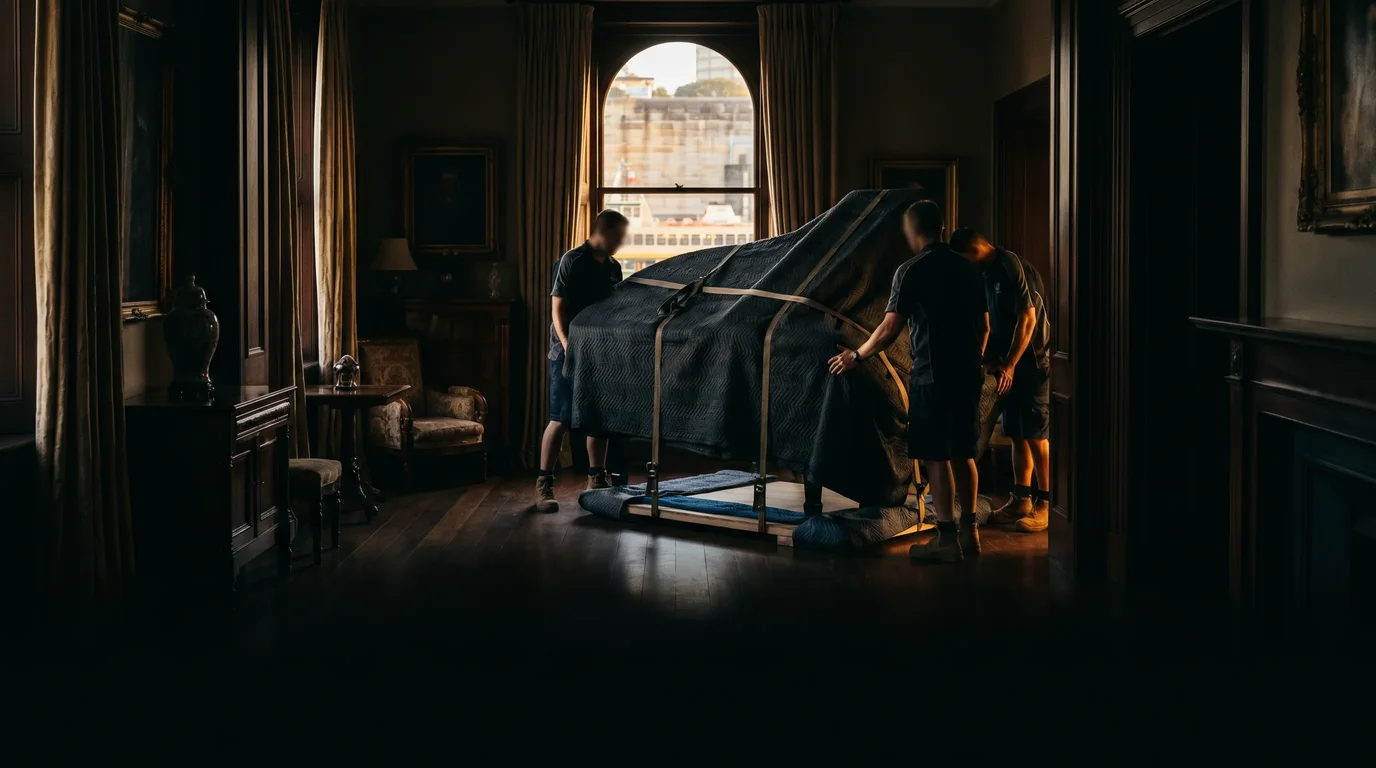
There is a reason the eastern harbour suburbs are known for what is inside the homes rather than just the addresses. A move from a Point Piper waterfront estate, a Bellevue Hill grand home on Victoria Road, or a Woollahra terrace near Queen Street is almost always, at some level, a conversation about the things that do not fit in a box.
A Steinway. A large framed canvas from a known artist. A wine collection in a temperature-controlled cellar. A marble dining table. These items set the pace of the day, and they are common enough in this catchment that they are the first thing we ask about when a new enquiry comes in.
This is a guide to how it actually works.
Why a grand piano is the hardest single item in any home
A baby grand in standard configuration weighs between 200 and 300 kilograms. A full concert grand is closer to 500. They are both wider than most internal doorways when assembled, and they have three legs, a lid and a body that require disassembly into specific pieces in a specific order, padded individually, and rebuilt at the other end.
The reason this matters in the eastern harbour is gradient and access. A Point Piper home on Wolseley Road or Wingadal Place often steps steeply down from the street toward the water. The piano is, in many cases, in the lowest level of the house, which means the carry path runs down through the house and then back up to the truck. That carry, with 300 kilograms of instrument in pieces on the right equipment, requires the crew and the stair space.
A Bellevue Hill home on Kambala Road or Bellevue Road sits on a steep ridge with the kind of internal staircase that was built for a house with a grand piano in mind. The challenge here is more often the driveway: long, sometimes curving, sometimes gated, with a tight turning radius for a truck that needs to be close enough to matter.
A Woollahra terrace on Moncur Street or Jersey Road adds a different challenge: the stairs are narrow and original, and they were genuinely not designed for large items. A piano has to be assessed and planned, not just attempted.
In all three cases, the answer is the same: assess the carry path before move day, bring the piano board, the skates, the stair-climbing gear and the right number of crew, and plan each stair and turn before a hand is laid on the instrument.
The council parking reality: Woollahra terraces and Rose Bay
A grand piano move (or any move with large, awkward items) depends on being able to hold a truck close enough to the door to be useful. In the eastern harbour suburbs, that is not always straightforward.
For moves in the Woollahra LGA, including Woollahra itself, Double Bay, Bellevue Hill, Point Piper, Darling Point, Edgecliff, Vaucluse and Watsons Bay, Woollahra Council has a formal Permit to Stand Plant. This is the permit a removalist uses to legally hold a vehicle on the kerbside for a loading or unloading job. It requires at least 48 hours notice, and it has an application fee. If the truck cannot keep 3 metres of lane clear, the job moves into a Temporary Road Closure, which requires a Traffic Management Plan and significantly more lead time.
What this means in practice: a professional removalist on a Woollahra terrace street does not just park on the kerb and hope. They apply for the permit as part of the job planning, confirmed well before move day. We do this as a matter of course for jobs in the heritage streets. If you are getting quotes for a move in this area, ask your removalist how they handle the parking. If they do not mention the permit, that is worth following up.
For Rose Bay, the picture is different. Rose Bay straddles two councils: the western side is Woollahra LGA, the eastern side is Waverley LGA. Waverley’s standard parking permits exclude vehicles over 4.5 tonnes or 6 metres in length, which covers almost every furniture truck. For jobs on the Waverley side, the approach is legal on-street parking with careful timing: early start, knowledge of the street, and a scout of the loading spot before move day. It works, but it requires a removalist who knows the difference.
Fine art: what the wrapping actually involves
A framed canvas is not a box. A mirror is not a window. A large oil painting in an ornate heritage frame is a combination of fragile canvas, gilded gesso and old timber that can fail in several places at once if it is handled wrong.
For moves in this catchment, art handling is a routine part of the job, not a special request. The approach:
- Framed works are individually wrapped in glassine or acid-free tissue before any bubble wrap touches the surface. This protects the paint layer and the gilt from abrasion.
- Corner protectors go on before blanket-wrapping, because a frame corner hitting a door jamb is the most common damage point.
- Art travels upright in the truck, not flat on its face, unless the piece is specifically designed to travel flat. Face-to-face with padding between is acceptable for smaller pieces; large canvases travel solo.
- We load art last so it unloads first and is never under pressure from other items in the truck.
For very large, very valuable or structurally fragile pieces, made-to-measure timber crating is available. This is the right answer for a piece that has significant financial or sentimental value and cannot be replaced.
Wine: the thing people forget to plan for
A wine collection in the eastern harbour is rarely a dozen bottles in a box. It may be several hundred bottles in a custom cellar, organised by region, vintage and label.
Wine has two enemies during a move: vibration (which disturbs sediment in aged bottles) and temperature (which expands the wine, stresses the cork and, on a summer’s day, can ruin a bottle in an unventilated truck in under an hour).
For a significant collection, the considerations are: moving in the cooler parts of the day, using appropriate wine-shipping boxes that hold bottles individually, minimising the time bottles spend outside a climate-controlled environment, and transport in a temperature-managed vehicle where the collection warrants it. Tell us the collection size and any particularly sensitive bottles when you enquire.
Access truths for each suburb: the short version
Point Piper (Wolseley Road, Wingadal Place, Wentworth Street): Steep descent to water, gated entries, very limited truck room at the peninsula tip. A shuttle or smaller vehicle is often planned.
Darling Point (Darling Point Road, Eastbourne Road, Mona Road): Mix of lift-equipped towers and older blocks with original, small lifts or stair-only access. Peninsula has one road in. Lift bookings and lobby protection are standard.
Woollahra (Queen Street, Moncur Street, Jersey Road): Heritage conservation area. Original terrace stairs. Woollahra Council Permit to Stand Plant required. Queen Street antique and gallery trade means genuinely valuable items are common.
Watsons Bay (Military Road, Cliff Street, Pacific Street): Narrow village streets, heavy visitor parking pressure. A shuttle vehicle and extra crew are frequently the plan.
Bellevue Hill (Victoria Road, Bellevue Road, Kambala Road): Generous but steep. Long driveways, tight turning circles. High-value contents are the norm.
Vaucluse (Wentworth Road, Hopetoun Avenue, Coolong Road): Large multi-level homes on steep blocks. Long carries between street and door.
What to tell us when you enquire
The more specific you are about the specialty items and the access, the more accurate your quote will be. Here is what helps:
- The item: Piano (make, size, which floor), art (framed size, canvas only or in frame), wine (approximate bottle count, do you have existing wine boxes), marble (dimensions and weight if known).
- The access: Number of stairs at origin and destination, any lifts and their dimensions, driveway length and gradient, any gates or tight turns.
- The building: Strata rules on lift access and lobby protection, loading dock availability at apartment buildings.
- The date: Woollahra Council permits need 48 hours minimum. Early notice is always better.
Start a quote here or explore the white-glove specialty-items guide to build your move picture before you call.
Common questions
Does a removalist need a council permit to park on a Woollahra terrace street?
Yes. Woollahra Council has a formal Permit to Stand Plant for temporary kerbside occupation. It requires at least 48 hours notice and carries a real application fee. Check current fees with Woollahra Council directly (council.woollahra.nsw.gov.au or 9391 7000). We lodge the permit as part of the job planning.
Can a full-size furniture truck get to my door in Watsons Bay?
Often not directly. The village streets (Military Road, Cliff Street, Pacific Street) are narrow and winding, and visitor parking pressure around the beaches and Doyles makes a hold difficult. We typically bring a shuttle vehicle and extra crew to bridge the gap between where the truck can safely stop and your front door.
What should I tell you when I enquire about moving a grand piano?
The make and size (baby grand, concert grand), the number of internal stairs between the piano room and the nearest level exit, whether the piano needs to go in or out through a window or balcony, and both addresses. That is enough for us to give you an accurate quote and confirm the crew and gear needed.
How is fine art moved safely in the eastern harbour?
Framed works travel flat, upright (never face-to-face without padding) or in made-to-measure mirror boxes, depending on the size and frame profile. Canvases that cannot be rolled stay rigid. We wrap before anything moves, protect corners and frames individually, and load art first so it is unloaded last. For very large or very valuable pieces, custom crating is available.
Planning a move?
Get a free, no-obligation quote and we'll plan the access at both ends with you.
Get a quote